Excerpt from Linus Torvalds’s answer in a Slashdot interview:
I’ve seen too many people who delete a singly-linked list entry by keeping track of the “prev” entry, and then to delete the entry, doing something like:
if (prev) prev->next = entry->next; else head = entry->next;
and whenever I see code like that, I just go “This person doesn’t understand pointers”. And it’s sadly quite common. People who understand pointers just use a “pointer to the entry pointer”, and initialize that with the address of the list_head. And then as they traverse the list, they can remove the entry without using any conditionals, by just doing:
*pp = entry->next;
In this post, we will explore the solution proposed by Linus. First, let’s look at the function to delete a node in a singly linked list as most people would typically write it:
// Delete `target` node from a singly linked list whose head is `head`.
void deleteNode(ListNode*& head, ListNode* target) {
  ListNode* entry = head;
  ListNode* prev = NULL;

  while(entry) {
    if (entry == target) {
      if (prev) prev->next = entry->next;
      else head = entry->next;
      break;
    }

    prev = entry;
    entry = entry->next;
  }

  delete target;
}
A bit of explanation about passing head by reference: if the head parameter is not passed by reference, we would only be able to delete nodes that are not the head (because the statement entry = entry->next for the first time—i.e., entry = head->next—allows entry to traverse the pointers allocated on the HEAP). We wouldn’t be able to handle the case where the head itself is being deleted, because in that case, the head pointer inside the function and the one outside are completely different. If target == head, the statement head = target->next would run. First, this only changes the head pointer inside the function (the head pointer outside the function remains unaffected). Second, it only changes where this internal head pointer points (to the memory at target->next), rather than actually modifying the pointer on the HEAP that the original head pointer points to. In summary, we pass head by reference so that any changes to head inside the function are reflected outside the function.
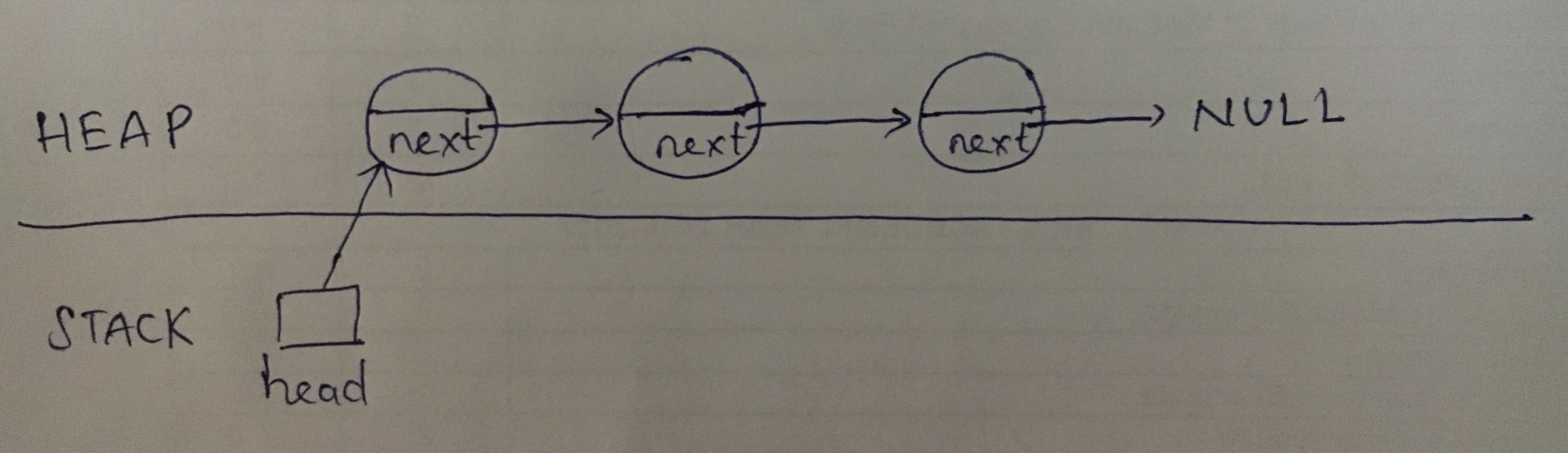
The above approach is not optimal because to delete a node, we need to know its preceding node. Since the head does not have a preceding node, this special case must always be handled. Linus Torvalds wants to avoid writing extra code for this special case by using a pointer-to-pointer (double pointer) to identify the “preceding” pointer for every node, including the head. To understand this, first, consider that if a singly linked list has n nodes, these nodes reside on the HEAP (at n memory locations). Each node contains a next pointer that points to the next node’s memory. So, which pointer points to the first node? That’s head! And it resides on the STACK:
First, initialize the entry pointer to point to the first node of the list:
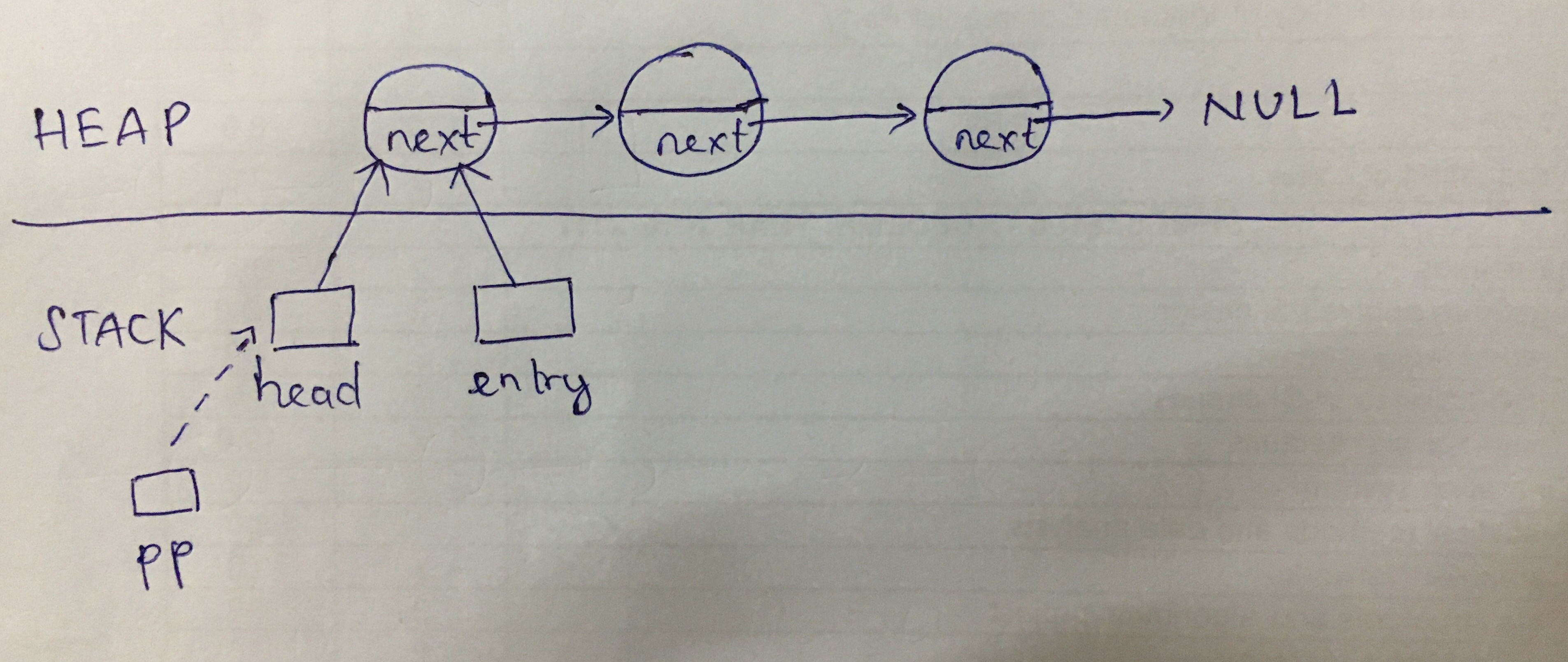
ListNode* entry = head;Nodes in the linked list are traversed by entry, similar to the first algorithm, and at any point, we need to know the pointer that points to the current node. When entry points to the first node, the head pointer on the STACK can be viewed as the pointer “preceding” the first node. Naturally, we need a pointer to this head pointer—a pointer-to-pointer (double pointer):
ListNode** pp = &head;Illustration of memory at this point:
Now, we no longer need to worry about the special case where the head node is deleted, as we have identified a pointer pointing to every node (even the first one). The rest of the logic is similar to the first algorithm. Here is the full code for the new approach:
// Delete `target` node from a singly linked list whose head is `head`.
void deleteNode(ListNode*& head, ListNode* target) {
  ListNode** pp = &head;
  ListNode* entry = head;

  while(entry) {
    if (entry == target) {
      *pp = entry->next;
      break;
    }
    pp = &(entry->next);
    entry = entry->next;
  }
  delete target;
}
And we can even do it without using entry:
// Delete `target` node from a singly linked list whose head is `head`.
void deleteNode(ListNode*& head, ListNode* target) {
  ListNode** pp = &head;
  while(*pp != target) {
    pp = &((*pp)->next);
  }
  *pp = target->next;
  delete target;
}